Sunday, May 24, 2020

Welcome to Nepali Tibetan Himalaya

If you are looking for a wonderful trekking experience with great alpine Himalayan view yet not too crowded in Nepal, Langtang National Park is the ultimate choice. Langtang is a region located in north central Himalayas of Nepal. Located 51 km from Katmandu Valley, this region is bordered by the Tibet autonomous region of China, making it a unique place where the Tibetan culture can be seen.

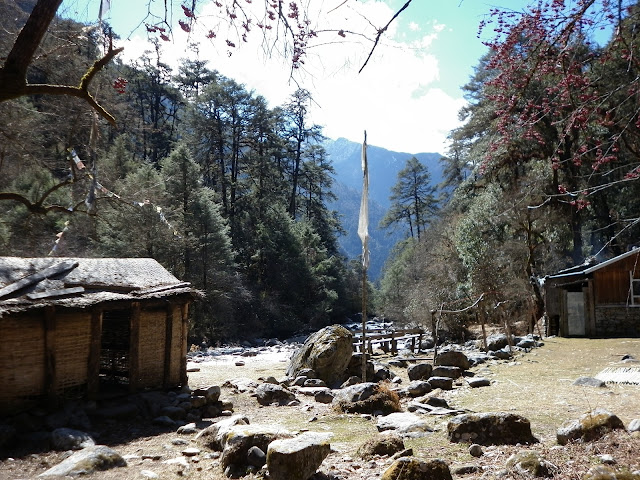
We did a 5 day trek in Langtang Kyangin Gompa Valley. The trek started in Syabrubesi and ended in Kyangin Gompa on Day 3, famous for its Buddhist Monastery. The view along the trek is awesome with great alpine view, especially in Kyangin Gompa. 

On Day 1, we trekked from Syabrubesi to Lama Hotel. As it was the first day of trek, it was tiring. 

Syabrubesi


Lama Hotel

On day 2, we continued our journey from Lama Hotel to Langtang Village. 


The tea house where we had lunch


Langtang Village


On day 3, we trekked to nearby valley village where we had a great glacier alpine view while relaxing at a tea house before lunch. Then, we continued our journey to Kyangin Gompa at 3800m.  As it was still winter in Feb, the weather was very cold upon reaching the guesthouse in the evening. We had butter milk tea to warm ourselves. 


Valley village with great alpine view

The tea house where we had lunch


The guesthouse in Kyangin Gompa


On day 4, we trekked back to Lama Hotel. 


Lunch at the tea house

One of the guesthouses in Lama Hotel

View from our guesthouse in Lama Hotel


On day 5, we trekked back from Lama Hotel to Syabrubesi, where we overnight in the local guesthouse before we came back to Katmandu the next day. 


Friendly villager in Langtang Valley

Final lunch on the trail

Toward the end of the trek

Finally reaching Syabrubesi

As Langtang was the first trek I did in Nepal, it was the first ever Himalayan glacier experience that left me in awe. The surrounding valley is mesmerizing with unique Tibetan cultural experience and awesome mountainous scenery. In fact, comparing to Poon Hill in the Annapurna region of Nepal which I did right after the Langtang trek, I would prefer Langtang to Poon Hill scenery.

Monday, May 4, 2020

KOYASAN - THE BIRTH PLACE OF SHINGON BUDDHISM

Mount Koya, a Unesco World Heritage Site, is located south of Osaka and Kyoto. It is the head quarter for Shingon School of Buddhism, founded by Kobo Daichi in 805AD. There are hundreds of temples and monasteries around the mountain. The best place to visit is in Autumn in November, where the autumn colors can be enjoyed.

Kongobuji Temple is the main temple built in 1593. It has the largest Banryutei Rock Garden in Japan.


Garan is Koyasan's central temple complex. The two most prominent buildings in Garan are the Kondo Hall and Konpon Daito Pagoda. Kondo Hall is a large wooden temple where major ceremonies are held. Konpon Daito Pagoda is an iconic bright 2 tier pagoda, standing at 45m tall.


Okunoin is the largest cemetery with over 200,000 tombstones lining along a 2 kilometre pathway with centuries old cedar tree. It is also the site of Kobo Daichi Mausoleum. Walking along the pathway in an early wet drizzling morning was like walking in a cloud.


The best experience in Mount Koya is to stay overnight at one of the Buddhist Temples. The temple lodging provides a ryokan like experience, where there is a tatami mat. Dinner was served in the room for the temple I stayed. Breakfast was held in the dining area.


Visiting Mount Koya is a relaxing experience, away from the hustle and bustle of the big city.

Friday, April 17, 2020

FLORES - THE HIDDEN GEM OF INDONESIA

When it comes to Indonesia, most would think of Bali, Java or more recently popular Lombok Island. What about Flores Island? It is a lesser known island in the East Nusa Tenggara, located between Lombok to the west and Timor Leste to the east.

The people and culture here are unique. Most of them are Catholic and the natives have curly hair like those in Papua New Guinea. To get from one tourist destination in the east to another in the west, it takes a very long journey in a few days. What I remember most about the island is the simple lifestyle, unique culture and beautiful lakes. The most memorable food I had was fried banana as there are many fried food stalls around, selling what they call in Indonesia "goreng gorengan", which simply translates to fried food.

There are many beautiful places to explore. We went to 4 key main highlights, the most iconic Kelimutu Lake, the traditional Bena Village, Cancar Spider Web Rice Field and the famous Komodo Island.

Kelimutu Lake
This is the key highlight where people come to witness the three color lake of the volcano. There are 3 lakes and at an undetermined time, there will be 3 different colors simultaneously. The 3 colors are mainly blue, green/white and red/dark brown. The color changes due to the chemical reactions in the volcanic basin. When we were there, we only saw 2 colors, red and blue. Kelimutu Lake is located in Kelimutu National Park. The best time to visit is early morning to catch the amazing sunrise at the summit. It only takes 30 mins to trek from the entrance.


Bena Traditional Village
It belongs to the Ngada tribe. The unique feature of the village is the high thatch roof with traditional megalithic culture still displayed. Stone monument in the center of the village is iconic. 


Cancar Spider Web Rice Field 
The paddy field here is divided among family members in a spider web formation. 


Komodo Island
It is the habitat of the world's largest monitor lizard, known as Komodo dragon. It has the most infectious saliva, full of  bacteria. This is how they prey by biting its victim and let the bacterial saliva infect the prey until it dies before eating it. There are jungle treks and breath taking views to go around the island. The view from Sulphurea Hill is amazing with volcanic mountain and sea backdrop.


Even though we went to only 4 key areas, the whole journey from the east to the west along the long shaped island took 9 days. That was because the transportation here was not fully developed for tourism as of 2010. The best way to travel is to rent a van, even that can take a whole day to travel from one destination to another.

Along the journey, we get to enjoy the rustic countryside view with paddy fields and seaside.


Flores has remained one of the less explored destinations. It was a blessing to travel with 2 friends whom we met through an earlier trip to Laos. 

Sunday, April 5, 2020

GREAT WALLS OF BEIJING

GREAT WALLS OF BEIJING

Have you ever wondered to visit one of the seven original wonders of the world, The Great Wall of China? To me, it was a dream came through when I visited Beijing in June 2019. There are in fact, few great wall sections around Beijing, mainly Badaling, Mutianyu, Jinshanling, Simatai, Gubeikou, Jiankou, Huanghuacheng, Juyongguan and Huangyaguan Great Walls. Most are fully restored, while some are partially restored and wild. I went to four of the great wall sections around Beijing.


Jinshanling Great Wall
Jinshanling Great Wall is considered one of the toughest as steep. It took me 4 hours to walk from one end (2nd bell tower) to the other end in the restored section. The view is superb, as there are wild greeneries around and not many people when I visited, hence less crowded.

How to get there: There is a direct tourist bus from the Dongzhimen Wai Bus Station that leaves at 7.40am. The bus returns at 4.00 pm (Apr-Oct peak season only)

How to get to Dongzhimen Wai Bus Station: Dongzhimen Wai stop is located to the Metro Line 2 Dongzhimen Stop, Exit B and you need walk around 5 to 10 mins to get to the corner of Xiang He Yuan S Street and Dongzhimen Wai Xie Jie, and Bus stop is outdoor there.


Mutianyu Great Wall
This great wall is more crowded and restored. In order to save time, I took a cable car up and toboggan down as a new experience. The surrounding view is more urban and less wild.

How to get there: There is a direct tourist bus from the Dongzhimen Wai Bus Station that leaves at 8.30am. The bus returns at 4.00 pm


Huanghuacheng Great Wall
Huanghuacheng Great Wall is one the most recently restored and open to public great wall. It has one of the most beautiful sceneries with mountain and dam as the backdrop.

How to get there: There is a direct tourist bus from the Dongzhimen Transportation Hub Station Station (Station 418) that leaves at 8.30am. The bus returns at 4.00 pm (Apr-Oct peak season only)
Alternatively, take bus 916/916 Express from Dongzhimen Transportation Hub Station to Huairou District (3rd Area of Hanhuayuan Stop) and change to bus H21 to Huanghuacheng


Simatai Great Wall
It is the only great wall that is open at night for a section. The view is superb with surrounding hills and it is quite steep as well. However, the section that is open to public is quite short with only 5-6 towers, hence, not very worth the entrance fee.

How to get there: There is a direct bus from the Dongzhimen Wai Bus Station via Gubei Ancient Town
Dongzhimen to Gubei Ancient Town: 8:00am to 15:30pm
Gubei Ancient Town to Dongzhimen: 11:00am to 21:00pm


Overall, I am fully impressed with the wonders of the Great Wall. Each of the Great Wall section has its own beauty. All are quite steep and great for hiking. I am glad to visit four Great Walls.


x

Wednesday, March 25, 2020

Koh Phayam - the 80s of Koh Samui

Most of us would have heard and dreamt of visiting those popular islands in South Thailand such as Phuket Island with the famous Patong Beach, Koh Phangan with full moon party and Koh Tao with one of the world's cheapest diving school. Have you heard of Koh Phayam? Neither did I until I googled for a smaller, more laidback island to visit in South Thailand.

Koh Phayam is a small island located in the southwest of Thailand, off Ranong town, near the Thai Myanmar border. 

The island can be reached by a speedboat from Ranong port in 40 minutes. Upon reaching, there will be motorbike taxi to ferry travelers from the port to the hotel. 

The island is best explored by motorbike. It is more of a local fishing village island being developed to cater to the growing tourists especially from Europe and Western Countries who would like to have a local village life atmosphere. If you are looking for a quiet, relax and laidback holiday, this is the place. But if you are looking for a nightlife with loud happening music, then this will be a wrong place. In fact, the key activity here is relaxing, swimming or sunbathing at the beach. There is not even an island hopping tour package as offered by resorts, unlike other popular islands. Another relaxing activity will be massage but do expect higher price than elsewhere. 

There are 2 main bays in the island, the quieter Buffalo Bay (Ao Khao Kwai) and more happening Long Beach Bay (Ao Yai). There is a hippie bar at Buffalo Bay. If you want to catch a sunset, Long Beach will be a perfect spot. There are also some viewpoints around the island for viewing from the higher ground, with restaurants where you may order food and drinks. One such place is located midway between Buffalo Beach and Long Beach, where you may view sunset from the platform. 

As most of the tourists are Europeans, the food here is at higher price, mainly at hotel cum restaurant type. There are also few local stalls along the roadside. I am told most of the tourists are repeat travelers who would go back to the island yearly or once in few years, just for the relaxing retreat. Some even treat it as a second home, whereby they come yearly to escape the cold winter months. In fact, the island can only be best visited from November to Mac. Most of the months from April to October are considered the raining season, where strong winds and rains are expected almost daily. In fact, some of the locals move to Ranong or other towns during the raining season. 

If you are looking for a relaxing island holiday, Koh Phayam would be one of the choices. It would be best to come as soon as possible before the island becomes too touristy and crowded like Koh Samui in 10-20 years time. Koh Phayam now is still like Koh Samui in the 80s.


Tuesday, March 10, 2020

DINAGYANG 2020

It was a blessing to watch one of the Philippine's grandest festivals, Dinagyang 2020 in Iloilo City on 24-26 Jan 20. Dinagyang is a yearly festival held on the 4th weekend of Jan. It is a religious and cultural celebration to honor the early settlement of Malay immigrants and most importantly, to show reverence to Child Jesus, Santo Nino.

The event started on Fri, 24th Jan, with school band performances, the fluvial procession to celebrate the arrival of Child Jesus, Santo Nino from Cebu, lighting parade in the evening which ended with a grand long fireworks at Megaworld Iloilo.


On Sat, 25th Jan, the event became more exciting with colorful procession and street performances of various groups in colorful and tribal costumes in the morning and afternoon. In the evening, colorful lights were illuminated on the colonial buildings in the old city, followed by a prayer session called religious sadsad, where the Father of the church gave a sermon with songs to honor Santo Nino with thousands of worshipers and revelers gathered. I personally think this is the most fun day, we get to take pictures with colorful performers and witness in close up the live performances on the street.


The last day of the festival on Sun, 26th Jan, was the grandest event ever held, the Ati Tribe Dance Competition called Dinagyang 360 Degrees. A so called gold ticket cost around 2200 peso to watch, even though I was seated at the 3rd row. It was a half day event with performances by 9 competing school based performing tribes. The winner would win 5 million peso to be announced in the evening.


Overall, Dinagyang is a once in a lifetime experience to witness and I am glad I made the right choice to visit Iloilo at the right time!